
Quick Answer: The best consent management platform (CMP) for European websites depends on business scale, targeted EU channels, and ad ecosystem dependencies. Leading options include Usercentrics and Didomi for multi-channel enterprise deployments, Cookie Information for EU data sovereignty and fast setup, and iubenda, CookieYes, or Complianz for budget-friendly setups.
We compared 10 CMPs, from enterprise platforms to WordPress plugins, on what they do, what they cost and who owns them.
Full disclosure: we built Cookie Information. We are transparent regarding how we compared each platform and honest in our assessments, so you can check our reasoning and make your own call.
Key takeaways
- Multi-Channel Consent: Usercentrics and Didomi cover web, mobile apps, and connected TV under unified enterprise management.
- Enterprise & Publisher Features: Didomi integrates cross-channel preference management and server-side tagging.
- EU Data Sovereignty: Cookie Information is the primary cloud CMP fully owned and operated within the EU with standard EU data storage.
- Pricing & Cost Structures: WordPress plugins (Complianz, Borlabs) offer low-cost self-hosted options, while mid-market CMPs average €10–€23 per month.
- Variable Metrics: Billing models vary significantly by domains, URLs, pageviews, sessions, or stored consent logs.
- Google Compliance: All evaluated platforms support Google Consent Mode v2 for European ad signal preservation.
Jump to section:
- Quick comparison
- What does a consent management platform cost?
- Who owns your consent management platform?
- Why do I need a consent management platform for my website?
- How we compared these CMPs
- What are the best consent management platforms for 2027?
- 1. Usercentrics: for consent across web, apps and connected TV
- 2. Didomi: for large publishers and enterprises
- 3. Cookie Information: for EU ownership and fast setup
- 4. Cookiebot: for automatic cookie scanning
- 5. iubenda: for small sites that need legal pages too
- 6. consentmanager: for agencies and high-traffic sites
- 7. CookieFirst: for a generous free plan
- 8. CookieYes: for small sites on a tight budget
- 9. Complianz: for WordPress sites that want to keep consent data in-house
- 10. Borlabs Cookie: for WordPress sites in German-speaking markets
- Which other consent management platforms might you come across?
- Which consent management platform is right for you?
- Frequently asked questions about consent management platforms
Quick comparison
Each platform suits a different kind of team. Usercentrics and Didomi focus on large, multi-channel setups. Cookie Information, Cookiebot, iubenda, consentmanager, CookieFirst and CookieYes suit small to mid-size businesses. Complianz and Borlabs Cookie are low-cost plugins for WordPress sites.
| Platform | Best for | What stands out | Paid plans from | Free option |
| Usercentrics | Teams that need one CMP for web, apps and connected TV | Consent signals for Google, Microsoft and Amazon ads | €7 per month | Free plan (under 1,000 sessions) |
| Didomi | Large publishers and enterprises | Consent plus preference management | Custom quote | No |
| Cookie Information | Marketing teams in the Nordics and the wider EU | EU-owned, live in about 5 minutes, with a visual editor and human support on every plan | €19.50 per domain per month | Free trial (length depends on plan) |
| Cookiebot | Small sites that want automatic cookie discovery | Mature scanner with a self-updating cookie declaration | €7 per domain per month | Free plan (up to 50 subpages) |
| iubenda | Small sites that need legal pages too | Cookie banner plus privacy and cookie policy generators | €4.99 per month, billed yearly | Free plan (up to 1,000 pageviews) |
| consentmanager | Agencies and high-traffic sites | IAB TCF and A/B testing from the Essential plan | €23 per month | Free plan (3,000 views) |
| CookieFirst | Small sites and agencies | Flat price per domain with a high traffic allowance | €9 per domain per month | Free plan (one script) |
| CookieYes | Small sites on a tight budget | Quick setup with a WordPress plugin | $10 per domain per month | Free plan (5,000 pageviews) |
| Complianz | WordPress sites | Consent records stay on your own server | €59 per year for one site | Free plugin |
| Borlabs Cookie | WordPress sites in German-speaking markets | No visitor data sent to the vendor | €49 per year for one site | No (30-day money-back guarantee) |
Prices checked on October 22, 2026 and shown without VAT. Billing models differ, so check the pricing details in each review and the CMP’s current pricing table before you buy.
What does a consent management platform cost?
List prices don’t tell you much, because every CMP measures usage differently. Some count domains, some count pages and others count pageviews, sessions or consents. So we priced the same typical business website on every platform.
Our example site has one domain, about 400 pages and about 60,000 pageviews (roughly 20,000 visits) a month. It shows the banner in two languages and needs automatic cookie blocking and consent records.
| Platform | Plan you’d need | Monthly price |
| Cookie Information | Essential (up to 500 URLs, 25,000 consents) | €19.50 |
| CookieFirst | Basic, or Plus for IAB TCF | €9 |
| iubenda | Advanced (Essentials has one language only) | About €20.50, billed yearly |
| CookieYes | Basic, or Pro for IAB TCF | $10 |
| consentmanager | Starter, or Essential for IAB TCF | €23 |
| Cookiebot | Premium Medium (350 to 3,499 subpages) | €30 |
| Usercentrics | Business (Pro stops at 15,000 sessions) | €50 |
| Didomi | Custom package | By quote |
| Complianz | Premium, one site (WordPress only) | About €5 (€59 per year) |
| Borlabs Cookie | Personal, one site (WordPress only) | About €4 (€49 per year) |
The WordPress plugins cost the least, but they only run on WordPress and you look after the consent records on your own server. Prices checked on October 22, 2026 and shown without VAT.
Who owns your consent management platform?
Ownership decides who can shape the product, the pricing and where your consent data ends up. That matters for data sovereignty, and many public sector buyers write EU ownership into their procurement rules.
Our CEO sees the same shift with customers:
“Digital sovereignty has become a serious concern. Companies want solutions that protect them if access to US‑operated services is restricted for political reasons.”

Karsten Rendemann
CEO, Cookie Information & Piwik PRO
(European Business interview)
The CMP market has consolidated fast, and several brands that look independent now share an owner:
- Usercentrics and Cookiebot: Usercentrics merged with Cybot, the Danish company behind Cookiebot, in 2021. Both products are now sold by Usercentrics.
- Didomi and Sourcepoint: Marlin Equity Partners, a US investment firm, made a majority investment in Didomi in 2025. Didomi then acquired Sourcepoint.
- The team.blue group: team.blue, a Belgian-Dutch digital services group, acquired a majority stake in iubenda in 2022. iubenda then acquired consentmanager in 2022 and CookieFirst in 2025. Complianz is also part of team.blue. All four are still sold as separate products.
Cookie Information is owned by its co-founders and Kirk Kapital, a Danish family office. EIFO, Denmark’s export and investment fund, has provided loans. Its consent data sits on EU servers in the Netherlands.
| Platform | Headquarters | Owner or main shareholders | Non-EU owners or investors? |
| Usercentrics | Munich, Germany | Full In Partners (New York), Alstin Capital, Cavalry Ventures and Reimann Investors. Google holds a stake of nearly 3%. (source) | Yes |
| Cookiebot | Copenhagen, Denmark | Part of Usercentrics since the 2021 merger with Cybot. (source) | Yes |
| Didomi | Paris, France | Marlin Equity Partners (US) holds a majority stake since 2025. Elephant (US), Breega and other investors also hold shares. (source) | Yes |
| Cookie Information | Copenhagen, Denmark | Co-founders and Kirk Kapital (Danish family office). EIFO, Denmark’s export and investment fund, provides loans. (source) | No |
| iubenda | Milan, Italy | team.blue holds a majority stake since 2022. Hg (London) is team.blue’s largest investor, with CPP Investments (Canada) and Sofina (Belgium). (source) | Yes |
| consentmanager | Sweden | Acquired by iubenda in 2022, so part of team.blue. (source) | Yes |
| CookieFirst | Amsterdam, Netherlands | Acquired by team.blue through iubenda in January 2025. (source) | Yes |
| CookieYes | Milton Keynes, UK | Mozilor Limited, with teams in the UK and India. (source) | Yes (UK and India) |
| Complianz | Groningen, Netherlands | Built by Really Simple Plugins, part of team.blue. (source) | Yes |
| Borlabs Cookie | Hamburg, Germany | Borlabs GmbH. (source) | None found |
Ownership checked on October 22, 2026, using company announcements, deal advisers’ notes and press. We count UK investors as non-EU.
Why do I need a consent management platform for my website?
A CMP shows your cookie banner, blocks non-essential cookies until visitors agree, stores proof of every choice and passes those choices to your ad and analytics platforms. In Europe, the General Data Protection Regulation (GDPR) sets the baseline for cookie consent. On top of the GDPR and the ePrivacy Directive, each market adds its own rules, and local data protection authorities (DPAs) enforce them in their own way.
Here’s what that looks like in some of the markets you might target:
| Market | Rule or authority | What it means for your banner |
| EU-wide | GDPR and ePrivacy Directive | Consent must be freely given, informed and recorded before non-essential cookies load. |
| France | CNIL cookie guidelines and recommendation | Rejecting must be as easy as accepting. In 2025, the CNIL fined Google €325 million and Shein €150 million over cookie consent. |
| Denmark | Danish Cookie Order, plus the Danish DPA (Datatilsynet) for personal data | Non-essential cookies need prior consent, and your banner must explain clearly what each cookie does. |
| Norway | Electronic Communications Act, section 3-15, in force since Jan 1, 2025, enforced by Nkom and Datatilsynet | Browser settings and pre-ticked boxes no longer count as consent. Visitors have to actively opt in. |
| Sweden | Electronic Communications Act (LEK), plus the Swedish DPA (IMY) for personal data | Non-essential cookies need prior consent that meets the GDPR standard. |
| Germany | Telecommunications Digital Services Data Protection Act (TDDDG) section 25 (formerly TTDSG) | Storing or reading information on a device needs consent unless it’s strictly necessary. |
| Italy | Garante cookie guidelines | Scrolling doesn’t count as consent, and you shouldn’t show the banner again for 6 months after someone rejects. |
| Spain | AEPD cookie guide | A ‘reject’ option needs to sit on the first layer of the banner, next to ‘accept’. |
These rules keep changing. The EU’s Digital Omnibus proposal could change how cookie consent works going forward. On October 21, 2026, EU governments agreed a position that keeps consent as the default but adds a few exemptions, such as first-party audience measurement. The European Parliament hasn’t agreed its position yet, so today’s rules still apply.
A solid CMP takes this work off your plate. It should:
- Apply the right consent rules for each market you target.
- Scan your site and keep your cookie list up to date.
- Let you design a banner that matches your brand and preview it before it goes live.
- Block scripts until visitors opt in.
- Let people change or withdraw consent at any time.
- Store consent records safely, ideally on servers in the EU.
- Pass consent signals to Google, Microsoft and other ad platforms.
- Show you opt-in rates and flag compliance risks before a regulator does.
If your revenue depends on Google Ads performance, the last two matter most. Google’s EU user consent policy expects a working consent signal from visitors in the EEA. Without one, you lose conversion data and remarketing audiences. That’s why advertisers need a Google Consent Mode v2 CMP, ideally one that Google has certified.
How we compared these CMPs
We started from the jobs a European marketing team needs its CMP to do, then checked every platform against five questions:
- Consent features: does it scan, block scripts, support Google Consent Mode v2 and IAB TCF, and report on opt-in rates?
- Channels: does it cover websites only, or mobile apps and connected TV too?
- Price: how easy is it to predict your bill as your traffic grows?
- Ownership and data location: who owns the platform, and where do your consent records live?
- Setup and support: how fast can you go live, and who helps when something breaks?
We only compare consent features. Several platforms also sell analytics, tag management or legal document generators, and we mention those where they’re relevant.
The order of the reviews isn’t a score. We start with platforms built for large, multi-channel setups, move on to platforms for small and mid-size businesses and finish with WordPress plugins. As the makers of Cookie Information, we’ve linked every price and claim to its source, and our own review lists the trade-offs too.
What are the best consent management platforms for 2027?
Here’s what each platform does well, what to watch for and what it costs.
1. Usercentrics: for consent across web, apps and connected TV
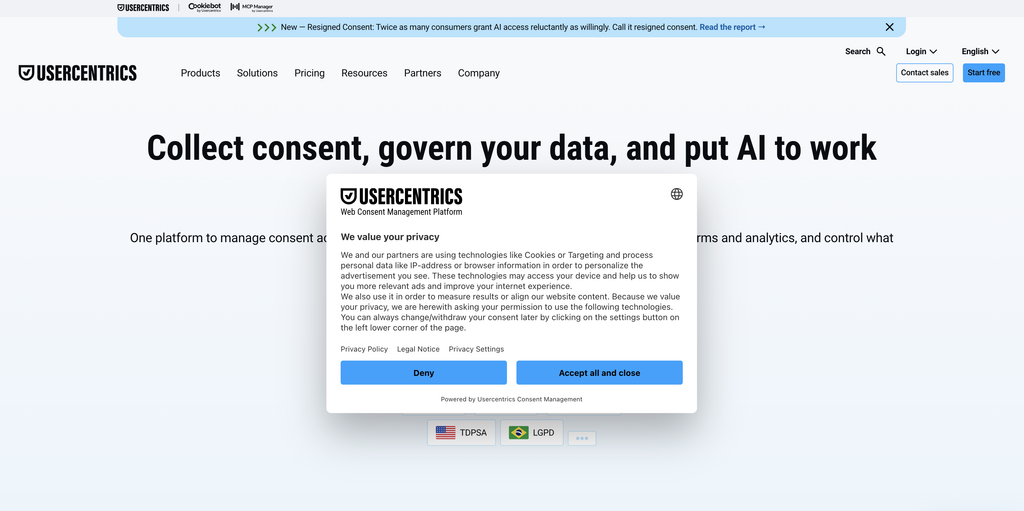
Usercentrics handles consent for websites, mobile apps and connected TV from one vendor. That helps if you want the same consent rules in every channel. It’s a Google-certified CMP that supports Google Consent Mode v2, Microsoft UET Consent Mode and Amazon’s consent signal, so your ad platforms get the right signal when someone says no. It also comes with 2,200+ ready-made templates for third-party services, so you don’t write legal text for each one.
Watch the bill as you grow. Plans are metered by sessions and move up a tier automatically when you pass your limit. A/B testing, role management and removing the ‘Powered by Usercentrics’ label sit on the sales-led Advanced plan.
What do reviewers say?
A G2 reviewer says Usercentrics adapts to changes like new consent modes and helps them meet legal needs in nine European countries. The same reviewer found Google Consent Mode problems hard to trace between vendors. (G2 review)
Top features
- Web, app and connected TV CMPs from one vendor, with app SDKs for iOS, Android, Flutter, React Native and Unity
- Consent signals for different ad networks
- IAB TCF support from the Pro plan
- Interaction analytics that show how people use your banner
Usercentrics pricing
The web CMP is free for one domain and under 1,000 sessions a month. Paid plans start at €7 per month (Essential, 1,500 sessions). Plus costs €15 (3,000 sessions), Pro €30 (3 domains, 15,000 sessions) and Business €50 (10 domains, 50,000 sessions). Above 50,000 sessions, Business tiers run from €100 to €750 for 1 million sessions. Plans above 1 million sessions are custom. Every plan starts with a 14-day free trial. See the official pricing page and the G2 reviews.
| Pros | Cons |
| Covers web, apps and connected TV in one contract | Session-based pricing moves you up a plan automatically as traffic grows |
| Sends consent signals to Google, Microsoft and Amazon | A/B testing and role management need the sales-led Advanced plan |
| 60+ banner languages on higher plans | Non-EU investors, including Google, hold shares (see ownership) |
2. Didomi: for large publishers and enterprises
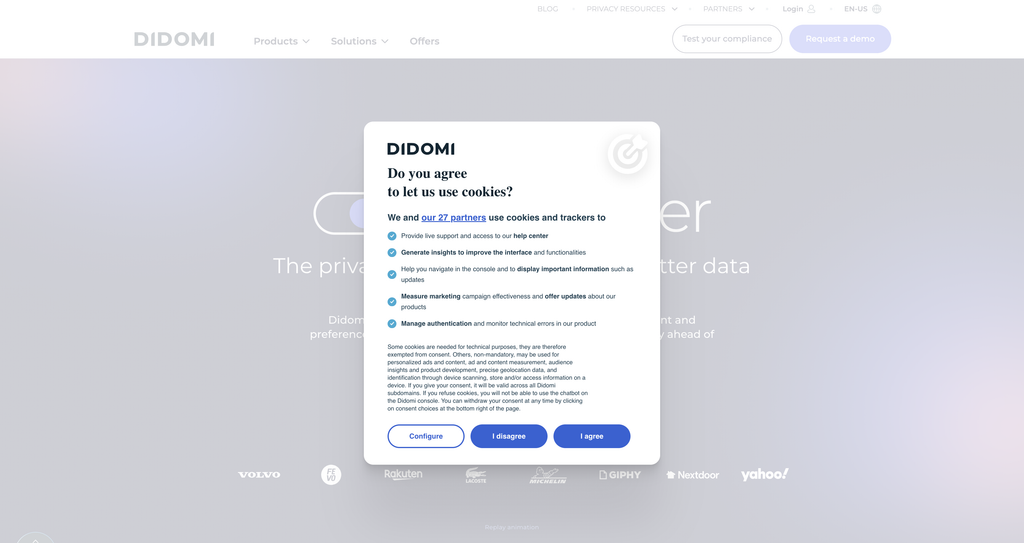
Didomi is built for big websites and publishers. It handles consent on the web, in mobile apps and on connected TV. It also goes beyond the banner with preference management, so people can choose how you contact them by email and other channels. In 2025, Didomi acquired Addingwell, which added server-side tagging, and Sourcepoint, which added 200+ enterprise customers, mostly publishers.
The trade-off is the buying process. There are no public prices and no free CMP plan, so you need to talk to a sales rep before you see a number.
What do reviewers say?
A G2 reviewer says Didomi makes consent management easy across multiple websites. They add that some settings feel technical at first. (G2 review)
Top features
- IAB TCF and GPP support for ad-funded sites
- Consent for web, mobile apps and connected TV
- Preference management that extends consent to email and other channels
- Server-side tagging through Addingwell
Didomi pricing
Didomi doesn’t publish its prices. The CMP comes in Essential, Advanced and Premium packages, priced on monthly unique visitors. Preference management is priced on database size and API calls. Request a quote on the Didomi site. Peer reviews are on Gartner Peer Insights.
| Pros | Cons |
| Strong fit for publishers and high-traffic sites | No public prices and no free CMP plan |
| Consent and preference management in one platform | Sales-led buying process can feel heavy for smaller teams |
| Google-certified for web, apps and connected TV | Majority owned by Marlin Equity Partners, a US investment firm |
3. Cookie Information: for EU ownership and fast setup
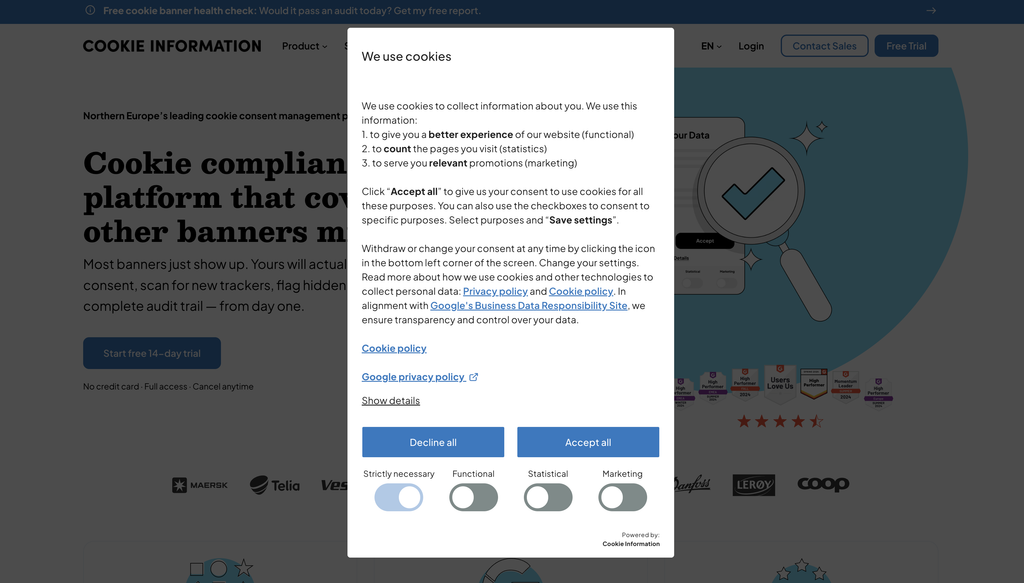
Cookie Information is built for marketing teams that want a compliant banner live fast, without waiting for a developer. You can go live in about 5 minutes with a WordPress or Drupal plugin, Google Tag Manager or one code snippet. From there, it scans your site, blocks cookies until people consent and keeps audit-ready consent records on EU servers.
Google Consent Mode v2 is built in, and Cookie Information is a Google-certified CMP. You design your banner in a visual editor with a live preview, so you see exactly what visitors will see before anything goes live, plus chat and email support from real people.
It’s the only cloud CMP in this comparison owned and operated entirely within the EU, and more than 5,000 organizations use it already. A few things to know: standard plans scan your site automatically once a week, though you can run an extra scan at any time. Daily automatic scans, mobile app consent, advanced integrations and dedicated onboarding are only in custom packages.
Need analytics too? The Business plan adds Piwik PRO Analytics Suite. It collects anonymous data from visitors who decline cookies, which gives you up to 4× more sessions in your reports than a CMP alone.
What do reviewers say?
“We googled all cookie banner tools. But Cookie Information was the only one that provided a cookie consent management platform we’re satisfied with.”

Jan Morten Andersen
GDPR Compliance Manager, CoreTrek, Norway
Top features
- Cookie blocking until consent, plus audit-ready consent records on EU servers.
- Google CMP partner with Gold Status and native Google Consent Mode v2.
- Visual banner editor with a live preview.
- Plugins and integrations for WordPress, Drupal, Optimizely, Google Tag Manager and Piwik PRO.
- Business plan: advanced dashboard with consent rate tracking and compliance risk alerts, plus Piwik PRO Analytics, Tag Manager and Data Activation tools.
Cookie Information pricing
Essential (cookie banner) costs €19.50 per domain per month for up to 500 URLs. Essential plan includes 25,000 consents a month, so you pay for consents, not pageviews. Business starts at €36 per domain per month and adds Piwik PRO’s privacy-friendly analytics, priced on domains and monthly actions. There’s no free plan, but you can start with a free trial (length depends on plan) without a credit card. See the pricing page and the G2 reviews.
| Pros | Cons |
| Owned and operated within the EU, with consent records on EU servers | No free plan, only a free trial |
| Live in about 5 minutes without a developer | Weekly automatic scans on standard plans, daily scans only in a custom plan |
| Human support on every plan | Each subdomain counts as a separate domain |
| Optional Piwik PRO bundle recovers data from visitors who decline cookies | Shorter integration list than the largest platforms |
Keep your consent data in the EU
Start a free trial and see your banner live in minutes.
4. Cookiebot: for automatic cookie scanning
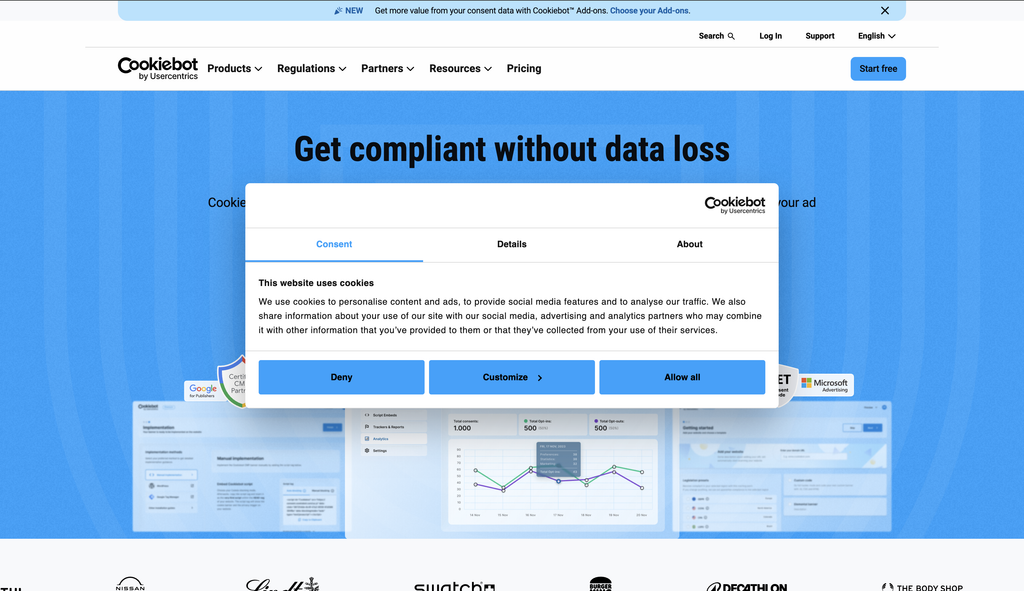
Cookiebot is the scanner-led CMP many teams know from WordPress. Its scanner finds the cookies and trackers on your site, sorts them into categories and keeps your cookie declaration up to date, so you don’t maintain the list by hand. Cookiebot is part of Usercentrics, but it’s still sold with its own per-domain plans. It’s Google-certified and supports Google Consent Mode v2 and IAB TCF.
Pricing is the part to check. You pay per domain, and your tier depends on how many subpages the scanner finds. Plans upgrade automatically when your site grows. The €15 Small plan only applies to accounts with four or more domains, so a single site with more than 50 subpages usually pays €30. Daily scans cost an extra €99 a month.
What do reviewers say?
A G2 reviewer calls Cookiebot’s automatic cookie scan accurate and says the banner can be customized to fit their brand design. (G2 reviews)
Top features
- Automatic scanning and categorization of cookies and trackers.
- Geotargeting, custom banner branding and 47+ banner languages.
- Google Consent Mode v2, Microsoft UET Consent Mode and IAB TCF.
- Manual and automatic cookie blocking until consent, plus email support (Premium plans only).
Cookiebot pricing
The free plan covers one domain with up to 50 subpages. Premium Lite costs €7 per domain per month (one domain, under 50 subpages). Premium Small (up to 350 subpages) costs €15 per domain, but only for accounts with four or more domains. Premium Medium (up to 3,500 subpages) costs €30, Large (up to 7,000 subpages) €50 and Extra Large €90 per domain. Every plan starts with a 14-day free trial. Independent reviews report that prices have been increasing for many accounts since August 2025. See the official pricing page and the G2 profile.
| Pros | Cons |
| Mature scanner that keeps your cookie list current | Per-domain and per-subpage pricing is hard to predict |
| Free plan for very small sites | Your plan upgrades automatically when a scan finds more subpages |
| Google-certified and backed by Usercentrics | Subdomains count as separate domains |
| Same non-EU investors as Usercentrics |
5. iubenda: for small sites that need legal pages too
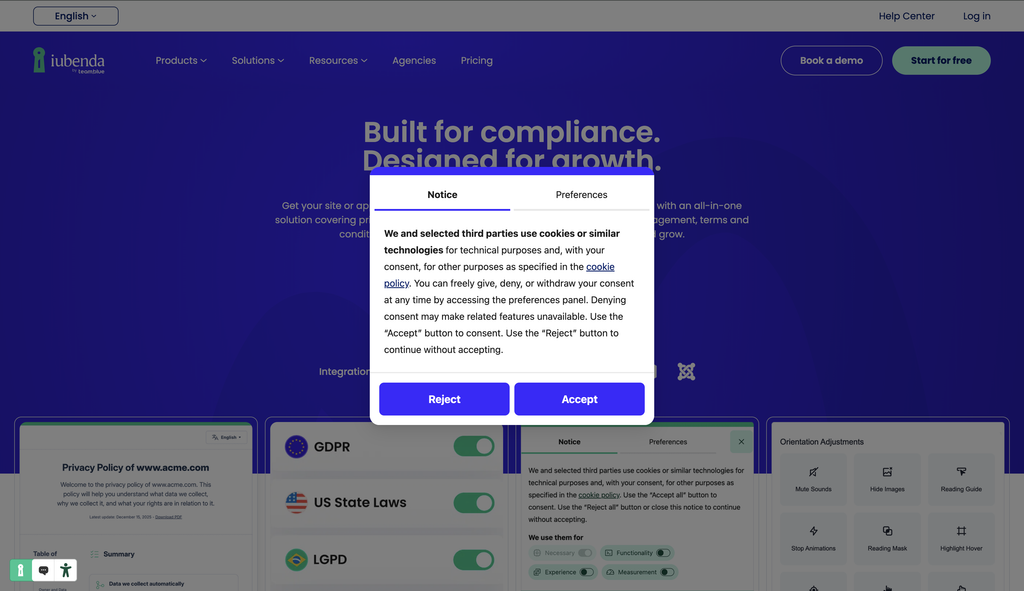
iubenda suits small sites that want consent and legal pages in one place. It started as a privacy policy generator, and one dashboard still gives you a cookie banner, a privacy policy and a cookie policy. Google Consent Mode support comes with every plan, even the free one.
iubenda is part of team.blue, the same group as consentmanager, CookieFirst and Complianz. It prices by pageviews, and the entry plan has limits worth checking: Essentials includes one banner language, up to 20 third-party services and monthly scans.
What do reviewers say?
A G2 reviewer says it’s easy to add cookie consent and a privacy policy with iubenda. They add that some admin options are confusing and take time to figure out. (G2 review)
Top features
- Cookie banner with Google Consent Mode support on every plan.
- Privacy policy and cookie policy generators included.
- Monthly scans on Essentials and Advanced, and more frequent scans with alerts on Ultimate.
- Consent analytics on higher plans.
iubenda pricing
The free plan covers simple sites with up to 1,000 pageviews a month. Essentials costs €4.99 per month billed yearly (€5.99 billed monthly) and includes 25,000 pageviews. Advanced costs €19.99 for 50,000 pageviews, and Ultimate costs €79.99 for 150,000 pageviews (both billed yearly). Extra pageviews cost €0.05 per 1,000. You can try any plan free for 14 days. See the official pricing page for the latest offers.
| Pros | Cons |
| Lowest entry price among the cloud CMPs here | Pageview-based pricing adds charges when traffic spikes |
| Consent and legal documents in one place | One banner language and monthly scans on Essentials |
| Google Consent Mode on every plan | Some reviewers find the admin options confusing |
| Part of team.blue, with non-EU investors |
6. consentmanager: for agencies and high-traffic sites
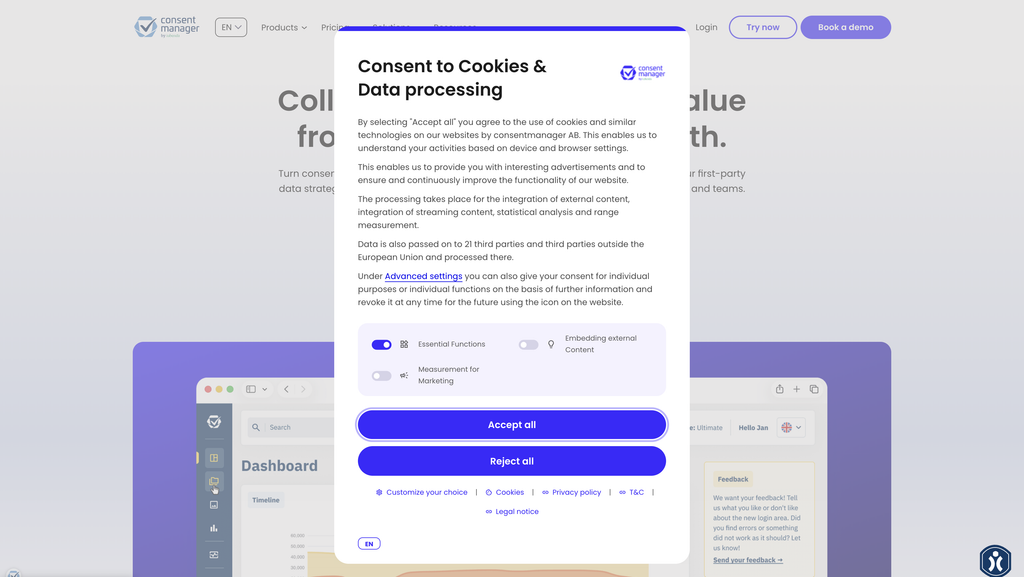
consentmanager is a Swedish CMP founded in 2018. iubenda acquired it in 2022, which makes it part of team.blue. It suits agencies and busy sites that want EU-only data storage and room to grow. Every plan blocks non-essential cookies until consent and includes Google Consent Mode v2.
IAB TCF only starts on the €59 Essential plan, and you pay per view above your monthly allowance.
What do reviewers say?
A Capterra reviewer says consentmanager’s app SDK lets them ask for consent with minimal code changes. (Capterra review)
Top features
- Cookie crawler that runs 3 times a day on Starter and 10 times a day on Essential.
- A/B testing to improve opt-in rates, from the Essential plan.
- Legal Shield and a privacy policy generator.
- White label and reseller workflows for agencies on bigger plans.
consentmanager pricing
The free plan includes 3,000 views a month. Starter costs €23 per month for 100,000 views and one website. Essential costs €59 for 1 million views. Bigger plans are custom. Extra views cost €0.11 per 1,000 on Starter and €0.05 on Essential. You can try paid plans free for 14 days. See the official pricing page.
| Pros | Cons |
| EU-only data storage on every plan | IAB TCF isn’t in Free or Starter |
| IAB TCF, GPP and A/B testing from Essential | You pay per view above your allowance |
| Cookie crawler runs several times a day | Part of team.blue, with non-EU investors |
7. CookieFirst: for a generous free plan
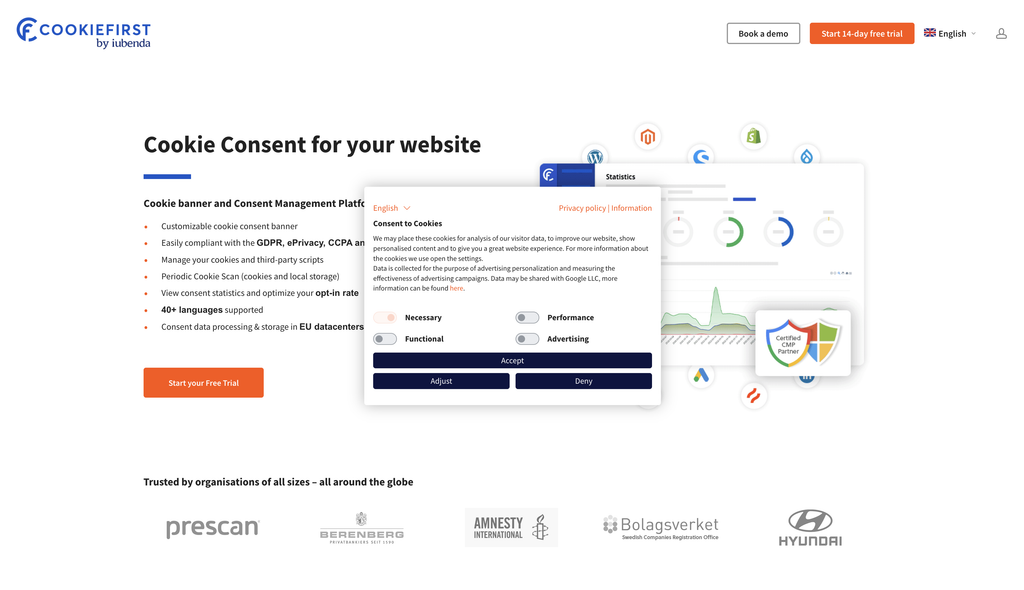
CookieFirst is a Dutch CMP founded in 2019. team.blue acquired it through iubenda in January 2025, and it’s still sold as its own product, mostly through agencies and resellers. The free plan has a soft limit of 250,000 pageviews per domain per month, which is generous. It’s also basic: one third-party script, a one-time scan and one language.
Paid plans start with Basic, which gives you all your scripts, monthly scans, multiple languages, consent statistics and a white-label banner. Plus adds IAB TCF, audit trails and opt-in rate tools.
What do reviewers say?
A G2 reviewer calls CookieFirst an ‘easy and fast way to implement consent management.’ They list price as the downside. (G2 reviews)
Top features
- Cookie banner or consent box, with banner customization.
- Monthly cookie scans.
- Consent audit trails and IAB TCF on Plus.
- White-label banner on paid plans.
CookieFirst pricing
The free plan costs nothing. Basic costs €9 per domain per month (€99 per year). Plus costs €19 (€209 per year). Annual plans include one free month, and Enterprise is custom. You can start with a 14-day free trial. See the CookieFirst pricing page and the G2 profile.
| Pros | Cons |
| Free plan with a high traffic limit | The free plan allows one script, one language and a single scan |
| Flat price per domain, not per pageview | Monthly scans only. IAB TCF needs Plus |
| White-label banner on paid plans | Costs add up if you run many domains |
| Part of team.blue, with non-EU investors |
8. CookieYes: for small sites on a tight budget
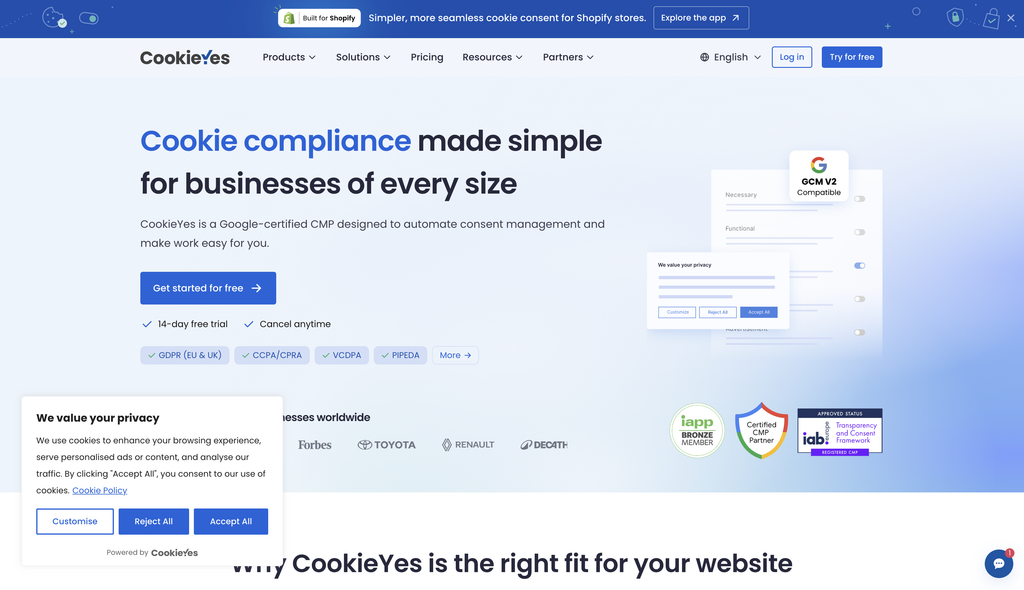
CookieYes is a budget-friendly pick for small sites. Its WordPress plugin has over 1 million active installs, and setup takes minutes. It’s a Google Gold-certified CMP, and the free plan covers one domain with 5,000 pageviews a month and a basic banner.
Costs grow with your traffic and your needs. You pay per domain, and extra pageviews on Basic and Pro cost $0.30 per 1,000. IAB TCF and geo-targeting start on Pro, and removing the CookieYes branding needs Ultimate. The company is based in the UK, outside the EU.
What do reviewers say?
A G2 reviewer calls CookieYes the easiest CMP they’ve found and likes the WPML translation and support. They find the price of removing the branding a bit high. (G2 review)
Top features
- Google Consent Mode v2, plus IAB TCF from the Pro plan.
- WordPress plugin and apps for other site builders.
- Auto-translated banner that follows the visitor’s browser language.
- Consent logs and consent trends.
CookieYes pricing
The free plan covers one domain and 5,000 pageviews a month. Basic costs $10 per domain per month for 100,000 pageviews. Pro costs $25 for 300,000 pageviews. Ultimate costs $55 for unlimited pageviews and branding removal. Extra pageviews on Basic and Pro cost $0.30 per 1,000. All paid plans include a 14-day free trial. See the official pricing page for tier package details.
| Pros | Cons |
| Easy setup with the WordPress plugin | Priced per domain, so multiple sites add up fast |
| Free plan and a low entry price | IAB TCF needs Pro, and the CookieYes branding stays until the $55 Ultimate plan |
| Google Gold-certified CMP | Overage fees on busy sites |
| Based in the UK, outside the EU |
9. Complianz: for WordPress sites that want to keep consent data in-house
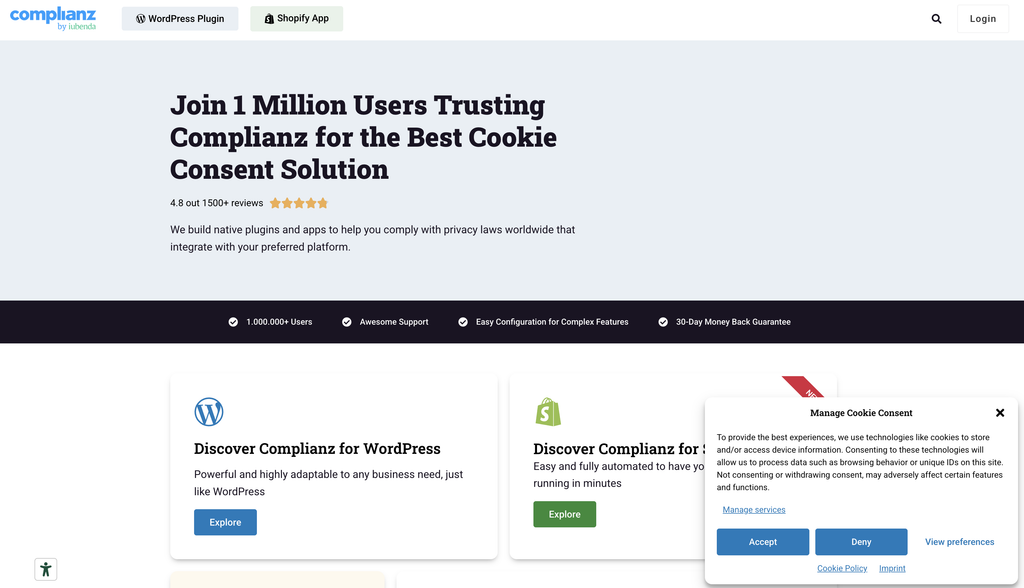
Complianz is a WordPress plugin from Groningen, the Netherlands, with more than 1 million active installs. It’s made by the team behind the Really Simple Security plugin, which is part of team.blue. Instead of running in a vendor’s cloud, it runs inside your WordPress site, so no visitor data goes to external servers. The free plugin covers a cookie banner, cookie scans, script blocking and a cookie policy, with no limit on stored consents. Premium adds IAB TCF, A/B testing, records of consent, geo-targeted banners and support for multiple sites.
The trade-off is reach and upkeep. It only runs on WordPress, and you’re responsible for keeping the plugin and your legal documents up to date. Premium features need an active license.
What do reviewers say?
A small IT company in France says on WordPress.org that the Complianz setup wizard made it easy to follow the GDPR and the CNIL guidelines. (WordPress.org review) Another reviewer running a WordPress multisite says the cookie scan didn’t pick up any cookies at first, and support took a few days to respond. (WordPress.org review)
Top features
- Blocks scripts, iframes and embeds like YouTube and Google Maps until consent, with placeholders.
- Detects 250+ WordPress plugins, themes and services automatically.
- Regular cookie scans, with descriptions from cookiedatabase.org.
- Wizard that generates your cookie policy.
Complianz pricing
The core plugin is free. Premium costs €59 per year for one site, €179 for five sites and €399 for 25 sites. There’s no pageview limit. See the Complianz WP plugin page for details.
| Pros | Cons |
| Low yearly price with no pageview limits | Works on WordPress only |
| Consent records stay on your own server | You host, maintain and back up the consent records yourself |
| Free version with no pageview or consent limits | Part of team.blue, with non-EU investors |
10. Borlabs Cookie: for WordPress sites in German-speaking markets
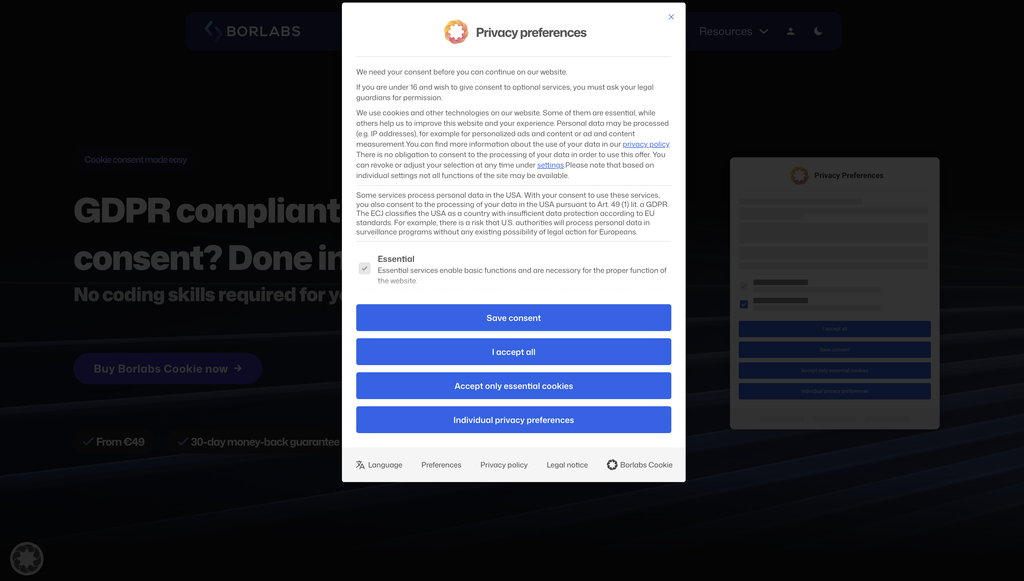
Borlabs Cookie is a WordPress plugin from Hamburg, used on more than 200,000 websites and popular in Germany, Austria and Switzerland. Like Complianz, it runs on your own server, and Borlabs says no visitor data reaches its own servers. It blocks cookies, scripts and embedded content like YouTube videos and Google Maps until visitors opt in, and it supports Google Consent Mode v2 and IAB TCF.
There’s no free version or free trial, only a 30-day money-back guarantee. It only runs on WordPress, and if your license expires, the scanner and the library of ready-made service packages stop working.
What do reviewers say?
A long-time agency user on Trustpilot rates the plugin highly but criticizes a large price increase for existing licenses. (Trustpilot review)
Top features
- Blocks cookies, scripts, styles and web fonts until visitors opt in.
- Content blocker for embeds like YouTube videos and Google Maps.
- Setup assistant with quick, custom or guided setup.
- Library of 370+ ready-made packages for popular services and plugins.
Borlabs Cookie pricing
Every license includes all features, unlimited pageviews and subpages, and email support. You pay by number of websites: €49 per year for one site, €79 for three, €109 for five, €179 for ten, €229 for 25 and €499 for 99, all excluding VAT. See the Borlabs Cookie listing and the vendor’s site for current prices.
| Pros | Cons |
| Low yearly price per site, with no pageview limits | Works on WordPress only |
| No visitor data sent to the vendor | No free version or free trial |
| Content blocker for embedded media | Scanner and package library stop working if your license expires |
Which other consent management platforms might you come across?
A few more names come up in European CMP searches. We didn’t review them in full, so check pricing and ownership before you add them to your shortlist.
- OneTrust (US): a large privacy suite where consent is one module. Pricing is sales-led.
- Cookie-Script (Lithuania): a low-cost CMP priced per domain.
- CookieHub (Iceland): a CMP with an option to store data only in the EU and EEA.
- Real Cookie Banner (Germany): a WordPress plugin with a free version.
- Sourcepoint (US): popular with US and UK publishers. It’s part of Didomi since the July 2025 acquisition.
Which consent management platform is right for you?
Start with the job you need done, then compare prices for your own traffic. Use this table to narrow down your shortlist.
| If you … | Look at |
| Run a large, ad-funded site or publisher | Didomi or Usercentrics |
| Need web, app and connected TV consent from one vendor | Usercentrics or Didomi |
| Want EU ownership, EU servers, human support and a setup that needs no developer | Cookie Information |
| Need IAB TCF on a mid-market budget | Cookie Information, CookieFirst or iubenda |
| Manage many client sites | consentmanager or CookieFirst |
| Want consent and legal pages together on a small site | iubenda |
| Run one small WordPress site on a tight budget | Complianz, Borlabs Cookie or CookieYes |
| Want automatic cookie discovery and accept per-domain pricing | Cookiebot |
Find the right cookie consent setup for your sites
Start a free trial, or talk to our team about multiple domains, mobile apps and daily scans. Start a free trial
Still have questions about the best CMP for your website? Find answers below.
Frequently asked questions about consent management platforms
Which consent management platforms are owned and operated in the EU?
Among the cloud CMPs in this comparison, Cookie Information is the only one owned and operated entirely within the EU. Borlabs Cookie is a German WordPress plugin that runs on your own server. The others have non-EU owners or investors. If you need an EU consent management platform for procurement reasons, check ownership as well as hosting. See the ownership table above.
Which consent management platform stores data in the EU?
Cookie Information stores consent data on EU servers in the Netherlands. consentmanager says it stores data only in the EU on every plan. Complianz and Borlabs Cookie keep consent records on your own server. Other vendors may host in the EU too, so check each vendor’s data processing agreement for the hosting location.
How much does a consent management platform cost?
Paid plans start at about €4 a month for WordPress plugins billed yearly, and at €4.99 for iubenda. For a typical business site with 60,000 pageviews a month that needs IAB TCF, expect to pay about €19 to €20 a month with Cookie Information, CookieFirst or iubenda, €30 with Cookiebot and €50 with Usercentrics. Didomi sells by quote.
Do I need a Google-certified CMP for Google Consent Mode v2?
Only if you publish ads. Publishers using AdSense, Ad Manager or AdMob must use a Google-certified CMP. Advertisers using Google Ads or Google Analytics need a CMP that supports Consent Mode v2 for visitors in the EEA, UK and Switzerland. Every platform here supports Consent Mode v2, some only on paid plans. Check the vendor’s status in Google’s CMP partner list. Read more about Google’s EU user consent policy.
What’s the difference between a cookie banner and a consent management platform?
A cookie banner is the popup visitors see. A CMP is the system behind it. It scans for cookies, blocks scripts until someone agrees, stores proof of each choice and passes signals to your ad and analytics platforms. A banner alone won’t make you compliant if scripts still fire before consent.
Does installing a consent management platform make me GDPR compliant?
No. A CMP helps, but it doesn’t guarantee compliance. Getting GDPR cookie consent right also depends on your setup: block scripts before consent, write clear banner text, offer an equal ‘reject’ option and keep your cookie list up to date. You also need a legal basis for the data you collect. Check your setup with a lawyer or privacy officer.
Is a consent management platform legally required in the EU?
Not by name. Data privacy laws like the GDPR and the ePrivacy rules require valid consent before non-essential cookies, but they don’t name a CMP. Business rules often do. Google’s EU user consent policy asks for consent signals, and ad networks that use IAB TCF expect a registered CMP. A CMP is the practical way to meet both.
Which consent management platforms have a free plan?
7 of the 10 on this list do: Usercentrics, Cookiebot, iubenda, consentmanager, CookieFirst, CookieYes and Complianz (as a free WordPress plugin). Free plans limit traffic or features. Didomi and Borlabs Cookie have no free plan. Cookie Information doesn’t either, but offers a free trial (length depends on plan).
Is Cookiebot the same as Usercentrics?
No, but they have the same owner. Usercentrics merged with Cybot, the company behind Cookiebot, in 2021. Today Usercentrics sells both products with different pricing: Cookiebot charges per domain and subpage count, and the Usercentrics CMP charges by monthly sessions.
Are iubenda, consentmanager, CookieFirst and Complianz the same company?
They’re separate products in the same group. team.blue acquired a majority stake in iubenda in 2022. iubenda then acquired consentmanager in 2022 and CookieFirst in 2025, and Complianz is also part of team.blue. Each consent tool is still sold with its own plans.


